
Products
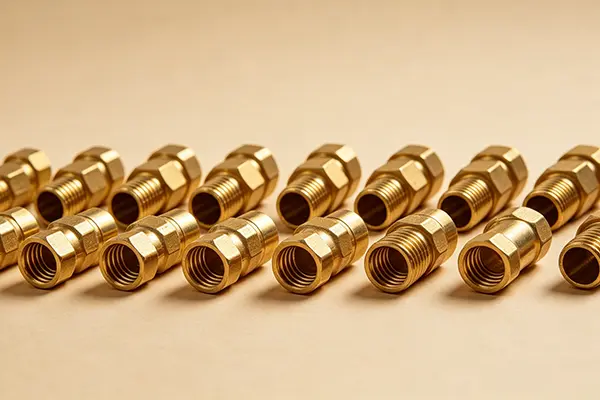
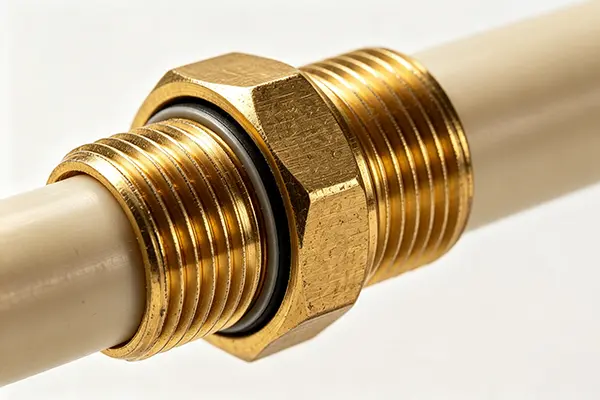
Our comprehensive product portfolio includes a wide range of brass rods (including low-lead and lead-free grades), brass fittings, and pipe components, engineered for exceptional mechanical strength, corrosion resistance, and machinability across plumbing, HVAC, automotive, and industrial applications.
Brass L-Type Hose Barb Connector
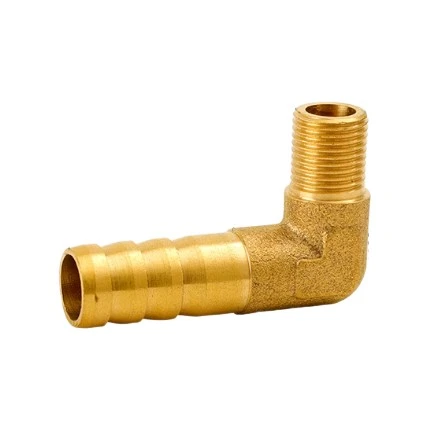
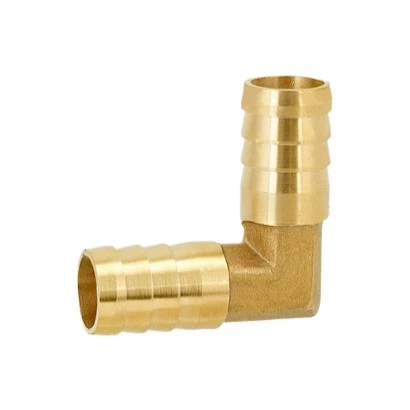
The Brass L-Type Hose Barb Connector is a 90-degree brass fitting for connecting flexible hoses in compact installations. Its right-angle design helps route fluid or air lines around machinery, control cabinets, automotive components, cooling equipment, and other restricted areas while reducing sharp hose bending. Thread options include BSP/G, NPT, PT/BSPT, and metric configurations.
The Brass L-Type Hose Barb Connector is a 90-degree brass fitting designed to connect flexible hoses in compact fluid, air, cooling, automotive, pneumatic, irrigation, and OEM equipment applications. Its right-angle structure helps reduce sharp hose bending, simplify routing, and save installation space. Available with BSP/G, NPT, PT/BSPT, and metric thread options, the fitting can be selected according to hose inner diameter, equipment interface, flow demand, pressure, temperature, and working medium.
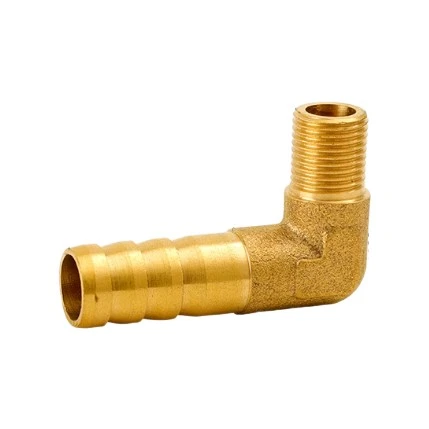
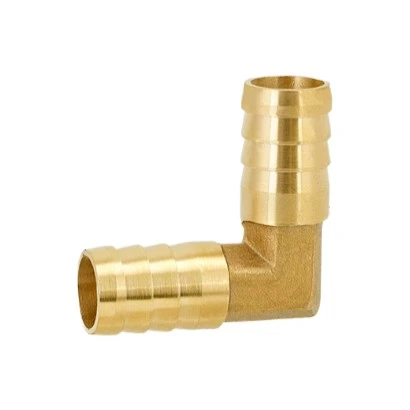
Connection Design
90-Degree Routing
The L-shaped body provides a built-in directional change, allowing the hose to turn without excessive bending near the connection point. This helps reduce hose stress and saves space in confined installations.
Barb and Thread Matching
The stepped barb provides multiple contact points inside the hose and is suitable for flexible tubing. A hose clamp is recommended for systems exposed to vibration, pressure fluctuations, or equipment movement.
The threaded end connects to equipment, manifolds, valves, adapters, or other threaded components. G/BSP, NPT, PT/BSPT, and metric threads differ in dimensions and sealing characteristics, so the required standard must be confirmed before ordering.
Internal Flow Path
Precision machining controls the internal passage and connection dimensions, helping maintain consistent flow performance. The fitting size should be selected according to the required flow capacity and system design.
Actual pressure loss depends on the fitting model, passage diameter, hose, fluid, temperature, flow rate, and number of bends in the circuit. NINGXING can provide model-specific flow or pressure-drop data when required.
Flow and Pressure-Drop Reference
The fitting creates local pressure loss as the fluid changes direction and passes through the barb and internal passage. Thread size alone is not sufficient for performance evaluation.
Important factors include the barb and internal passage diameter, hose inner diameter and length, fluid type and viscosity, flow rate, operating temperature, number of fittings and bends, hose clamp position, and connection condition.
The following table is intended for preliminary selection only and does not replace model-specific testing.
| Nominal Hose / Fitting Size | Recommended Application Range | Flow Evaluation Priority | Pressure-Drop Expectation |
|---|---|---|---|
| 1/8 inch / DN6 | Low-flow air, water, and auxiliary lines | Confirm passage and hose ID | Higher relative loss at the same flow rate |
| 1/4 inch / DN8 | Small pneumatic and water circuits | Check flow demand and hose length | Suitable for low to moderate flow |
| 3/8 inch / DN10 | General air, water, and cooling lines | Compare barb ID with hose ID | Moderate loss depending on flow rate |
| 1/2 inch / DN15 | Pneumatic equipment and cooling circuits | Verify continuous flow demand | Lower loss than smaller sizes at equal flow |
| 3/4 inch / DN20 | Larger cooling and water circuits | Confirm pump or compressor capacity | Suitable for moderate flow applications |
| 1 inch / DN25 and above | Higher-capacity fluid routing | Request model-specific data | System design and hose size become critical |
For engineering selection, provide the fitting size, hose inner diameter, working medium, temperature, target flow rate, inlet pressure, and required outlet pressure. NINGXING can then review the configuration and provide available performance information.
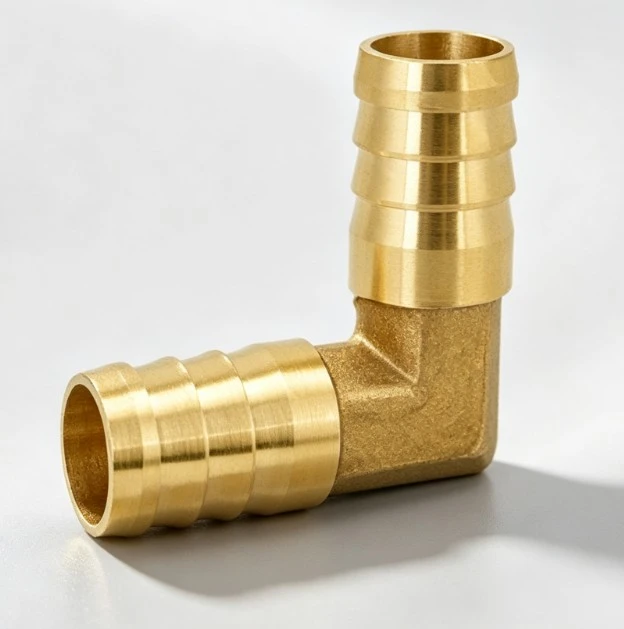
Material and Manufacturing
Brass Construction
Brass offers good machinability, mechanical strength, and corrosion resistance for many general-purpose fluid and air applications. Compatibility should be checked for oil, fuel, chemicals, and other demanding media.
CNC Machining
NINGXING uses CNC machining to control barb diameter, thread geometry, connection alignment, and internal passage dimensions. Production is managed under an ISO 9001:2015 quality management system, with dimensional inspection and leakage testing applied according to product and order requirements.
Surface Options
The Brass L-Type Hose Barb Connector can be supplied with a natural brass finish or nickel plating. Brass grade, surface treatment, thread standard, and other specifications can be discussed according to the application and destination market.
Installation Considerations
Hose Selection
The hose inner diameter must match the barb diameter rather than the nominal thread size. Rubber, PVC, PU, nylon, TPE, and other flexible tubing may be used when their pressure, temperature, hardness, wall thickness, and fluid compatibility meet the application requirements.
Clamp Installation
Push the hose fully onto the barb before installing the clamp. The clamp should provide sufficient compression without damaging the hose. After assembly, check that the hose remains seated and that no leakage is visible.
Thread Selection
Before ordering, confirm the thread standard, nominal size, male or female configuration, and sealing method required by the equipment.
Flow-Oriented Installation
To limit pressure loss, avoid using a hose with a smaller inner diameter than the fitting passage. Keep routing short and smooth, prevent hose flattening near the elbow, and position the clamp behind the barb shoulder.
Product Comparison
Directional and Branching Connections
| Product Type | Best For | Main Benefit | Flow and Installation Notes |
|---|---|---|---|
| Brass L-Type Hose Barb Connector | Turning a flexible hose 90-Degrees in a restricted area | Reduces sharp bending and saves space | Confirm hose ID, passage, flow rate, and pressure drop |
| Brass Straight Hose Barb Connector | Direct hose routing with sufficient linear space | Simple flow path and installation | Usually has lower directional loss than an elbow |
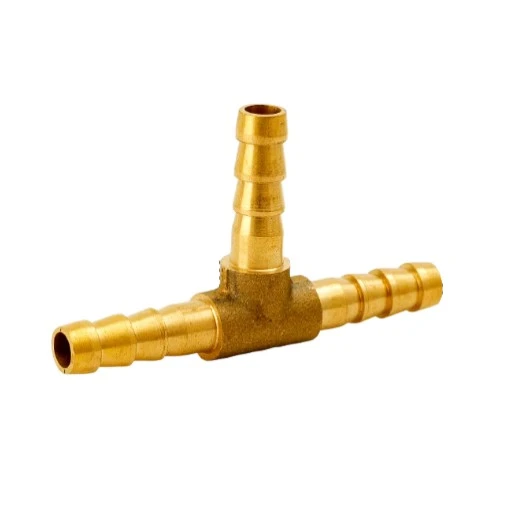
| Brass T-Type Hose Barb Connector | Dividing or combining flow in three directions | Creates a lateral branch | Check branch balance, total flow, and outlet loss |
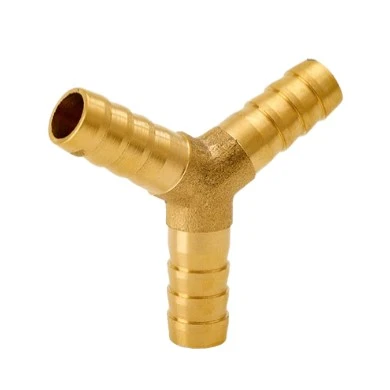
| Brass Y-Type Hose Barb Connector | Angled branching and smoother routing | Provides a gradual branch direction | Confirm flow distribution and clearance |
| Brass Elbow Threaded Fitting | Changing direction in rigid threaded piping | Suitable for pipe and manifold layouts | Requires an adapter for flexible hose |
Equipment Interface and Tube Connections
| Product Type | Best For | Main Benefit | Flow and Installation Notes |
|---|---|---|---|
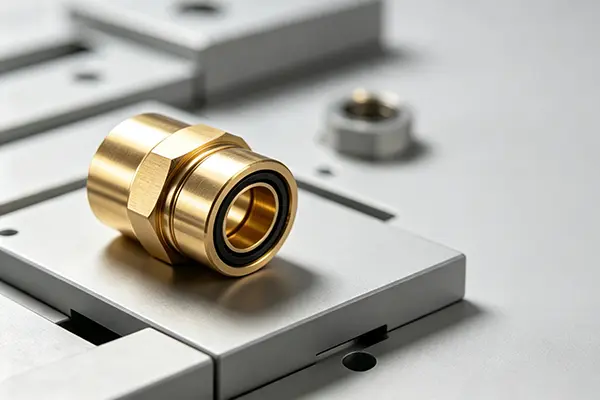
| Brass Female Thread Hose Adapter | Connecting a hose to male-threaded equipment | Provides a female-threaded interface | Match thread, sealing method, hose ID, and flow |
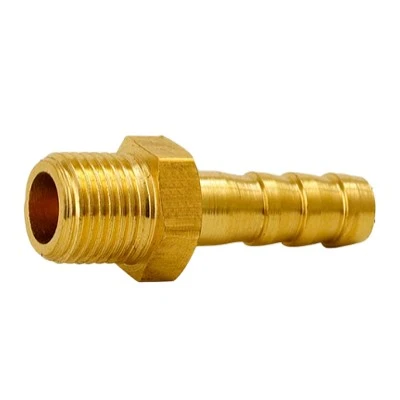
| Brass Male Thread Hose Adapter | Connecting a hose to female-threaded equipment | Provides a compact male connection | Confirm thread size, barb diameter, and pressure |
| Push-In Tube Fitting | Fast connection of rigid or semi-rigid tubing | Enables quick assembly and disconnection | Select by tube outside diameter and pressure rating |
| Compression Tube Fitting | Connecting rigid or semi-rigid tubing | Provides a mechanically compressed joint | Correct tube diameter and ferrule installation are essential |
Selection Guide
Choose the Brass L-Type Hose Barb Connector when a flexible hose must turn 90-Degrees near an equipment port or when installation space is limited. Use a straight barb connector for direct routing where lower directional loss is preferred.
T-type and Y-type connectors are intended for branching or combining lines, while threaded elbows are designed for rigid piping. Push-in and compression fittings are generally better suited to rigid or semi-rigid tubing.
For flow-sensitive systems, compare the effective internal passage rather than relying only on nominal thread size.
Typical Applications
Automotive Systems
Suitable for selected cooling, air, vacuum, and auxiliary fluid routing applications when the brass, hose, and sealing materials are compatible with the operating conditions.
Pneumatic Equipment
The right-angle design helps route compressed-air hoses around valves, cylinders, manifolds, and other components. Buyers should confirm the required air flow, inlet pressure, operating pressure, and acceptable pressure drop.
Mold Temperature Control
The fitting can simplify flexible hose routing in cooling-water circuits around molds and machine components. Selection should consider cooling demand, water temperature, pump output, and total circuit resistance.
Irrigation and Garden Equipment
For suitable low- to moderate-pressure water applications, the barb connection provides a practical method for joining flexible tubing in compact assemblies. Hose inner diameter and required water flow should be checked before selection.
Available Sizes
The following dimensions are reference data for the threaded connection series. Actual barb dimensions, thread standards, internal passage sizes, and product combinations should be confirmed for the selected model.
| Size | Alias | Nominal Thread Size | Major Diameter (mm) | Minor Diameter (mm) | Thread Pitch (mm) |
|---|---|---|---|---|---|
| 1/8 inch | DN6 | G1/8 | 9.728 | 8.566 | 0.907 |
| 1/4 inch | DN8 | G1/4 | 13.157 | 11.455 | 1.337 |
| 3/8 inch | DN10 | G3/8 | 16.662 | 14.950 | 1.337 |
| 1/2 inch | DN15 | G1/2 | 20.955 | 18.631 | 1.814 |
| 3/4 inch | DN20 | G3/4 | 26.441 | 24.117 | 1.814 |
| 1 inch | DN25 | G1" | 33.249 | 30.291 | 2.309 |
| 1-1/4 inch | DN32 | G1-1/4" | 41.910 | 38.952 | 2.309 |
| 1-1/2 inch | DN40 | G1-1/2" | 47.803 | 44.845 | 2.309 |
| 2 inch | DN50 | G2" | 59.614 | 56.656 | 2.309 |
| 2-1/2 inch | DN65 | G2-1/2" | 75.184 | 72.226 | 2.309 |
| 3 inch | DN80 | G3" | 87.884 | 84.926 | 2.309 |
| 4 inch | DN100 | G4" | 113.030 | 110.070 | 2.309 |
Additional tubing sizes, including φ10, φ12, φ16, 1/4", 3/8", and 1/2", can be discussed according to the required barb diameter and connection configuration.
Reference working conditions are vacuum pressure down to -100 kPa and temperatures from approximately -20°C to +100°C. The allowable pressure depends on the connected hose and complete system.
Quality Control
NINGXING inspects critical features such as thread geometry, barb profile, connection alignment, and internal passage dimensions. Leakage testing is applied according to the product specification and customer requirements.
For flow-sensitive orders, additional verification may include internal passage measurement, flow testing, pressure-drop testing, or test documentation under an agreed medium and operating condition.
Inspection standards and documentation can be agreed before production for customized orders.
Certifications
NINGXING manages production under an ISO 9001:2015 quality management system and provides products meeting applicable CE and RoHS requirements. Certification and compliance documents can be supplied according to the product model and target market.
FAQ
Which hose should be used with this fitting?
The fitting can be used with compatible flexible hoses such as rubber, PVC, PU, nylon, and TPE tubing. The hose inner diameter must match the barb diameter, and the hose must meet the required pressure, temperature, and fluid compatibility conditions.
Is a hose clamp necessary?
A clamp is recommended for pressurized, vibrating, or mobile applications because it improves hose retention. The clamp type and tightening force should match the hose material.
How do I choose the correct size?
Confirm the hose inner diameter, equipment-side thread specification, required flow capacity, and acceptable pressure drop. Also verify whether the system requires G/BSP, NPT, PT/BSPT, or metric threads.
Does the fitting have flow or pressure-drop data?
Performance depends on the exact model, internal passage, hose, medium, temperature, and flow rate. NINGXING can provide available test data or review the operating conditions for a specified model.
How can I reduce pressure loss?
Use an adequate passage size, match the hose inner diameter correctly, avoid undersized tubing, minimize unnecessary bends, and keep the routing smooth. For high-flow systems, request model-specific pressure-drop data.
Can different thread standards be customized?
Yes. Customized thread configurations and other non-standard dimensions can be produced according to drawings, samples, or technical specifications.
What operating temperature can it handle?
The reference temperature range is approximately -20°C to +100°C. The actual limit depends on the brass material, hose, sealing method, working medium, and system conditions.
Can it be used for oil or fuel?
It may be suitable for certain oil or fuel applications, but compatibility must be confirmed for the specific medium, temperature, pressure, hose, and applicable regulations.
Is it suitable for rigid tubing?
It is primarily designed for flexible hose connections. Push-in fittings, compression fittings, or tube-specific adapters are generally more suitable for rigid or semi-rigid tubing.
Hot Tags: Brass L-Type Hose Barb Connector, China, Manufacturer, Supplier, Factory
Related Category
Send Inquiry
Contact Info
-
Address
No. 478, Daijia North Road, Industrial Zone, Changhe Town, Cixi City, Zhejiang Province, China
-
Tel
-
Email
Need brass rods or custom fittings? Send your drawings or samples today. ISO9001 certified, RoHS & PED compliant. Get a fast, professional quote from our expert team. Inquire now!